
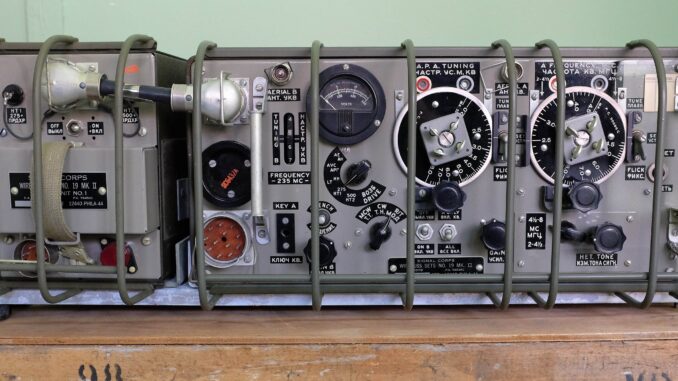
GARC August Meeting – The Wireless Set No. 19
Grantham Amateur Radio Club (GARC) will be showing a short video and hosting a discussion on the WS19 at their August meeting. If all goes well, there will also be an original WS19 set on display for members to examine up close.
The Wireless Set No. 19, affectionately known as the WS19, holds a special place in the world of amateur radio. Originally designed for World War II armoured vehicles, the WS19 became widely available as military surplus after the war, capturing the imagination of radio amateurs around the world. Here’s why this iconic set remains a favourite among hams even today.
A Classic HF-Capable Transceiver
The WS19 features a high-frequency (HF) transceiver, known as the “A-set” that covers approximately 2–8 MHz. This makes it suitable for use on or near amateur bands like 80 m and 40 m, especially for AM and CW operation. Its integrated Morse key and support for amplitude modulation mean that the set can be operated with minimal modification.
Surplus Legacy and Accessibility
Following WWII, thousands of these radios entered the surplus market. UK, Canadian, and American versions flooded amateur radio clubs and home workshops. Their affordability and robust military-grade construction made them an ideal entry point into vintage radio operation.
Restoration Projects and Technical Challenge
Hams drawn to the technical side of the hobby enjoy the WS19 for its restoration potential. Rebuilding power supplies, troubleshooting valves (tubes), and replacing missing or damaged components can be both a rewarding challenge and a practical education in analog electronics.
Built-In Intercom: A Unique Bonus
The WS19 includes a crew intercom amplifier system, or “L-set” which allowed armoured vehicle crews to communicate internally. For amateur radio operators, this feature adds an extra layer of curiosity and restoration interest, especially for field demonstrations.
Community and Documentation
There is a rich online and printed ecosystem of manuals, diagrams, and modification guides for the WS19. Communities of enthusiasts have built repositories of information to support newcomers to restoration or operation. Popular modifications include:
- 12 V DC power supply conversions
- Modern antenna tuning solutions
- Improved audio filters
Field Days and Historical Demonstrations
The WS19 often makes appearances at field day events, museums, and historical re-enactments. Some amateurs even participate in contests using only restored military gear, with the WS19 being a centrepiece of such operations.
Why It Still Matters
Owning and operating a WS19 is more than nostalgia—it’s an exploration of radio history, an exercise in practical restoration, and a tribute to the global amateur spirit. Whether you’re looking to learn vintage electronics, chase rare contacts with valve gear, or showcase a working piece of wartime communications, the Wireless Set No. 19 continues to deliver.
Quick Reference: WS19 for Amateur Radio
- Type: HF/VHF military transceiver
- HF Coverage (A-set): 2–8 MHz (voice and CW)
- Modes Supported: AM, CW, MCW
- Output Power: ~2.5–9 W depending on model
- Valve (tube) technology: Yes
- Power Supply: Originally 12 V or 24 V DC (via dynamotor); mods available
- Intercom: Built-in L-set for internal crew communication
- Typical Use Today:
- Vintage QSO and special events
- Military radio reenactments
- Restoration and homebrew workshops
- Modifications Commonly Done:
- Modern PSU conversion
- Improved modulation fidelity
- B-set deactivation (VHF)