
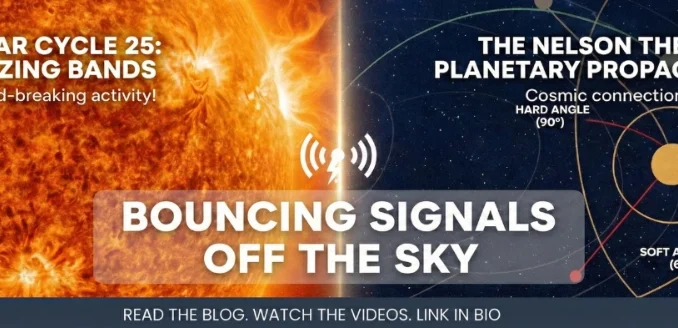
Bouncing Signals Off the Sky: A Recap of Our Recent Talk
On February 3rd, the Grantham Amateur Radio Club gathered to dive into the “magic” that makes our hobby possible: HF propagation. Whether you’re a seasoned DXer or just getting started, understanding how the sun interacts with our atmosphere is the key to filling your logbook.
If you missed the session, here’s a breakdown of the core concepts we discussed.
1. Solar Cycle 25: Exceeding All Expectations
We are currently riding the wave of Solar Cycle 25. While official predictions suggested a modest peak of around 115 sunspots, the sun had other ideas. In October 2024, we hit a smoothed sunspot number of 161. This increased solar activity means better ionisation and more frequent openings on the higher bands.
2. The Ionosphere: Our Invisible Mirror
When we key the mic here in Grantham, our signals head toward the ionosphere—a region of the atmosphere (50km to 600km+ up) electrified by solar radiation. This “mirror” is actually a series of layers:
- D Layer: “The Sponge.” During the day, it absorbs lower-frequency signals (80m and 40m).
- E Layer: Can act as a “trampoline” for shorter-distance, local contacts.
- F Layers (F1 & F2): The DX powerhouse. The F2 layer is the highest and strongest reflector, responsible for those incredible long-haul contacts around the globe.
3. Day vs. Night: A Different Radio World
The sun’s daily rhythm completely changes the rules of the game:
- Daytime: The D layer is thick and hungry, soaking up low-band energy. Meanwhile, the F layer splits, opening up the higher bands.
- Night-time: The D layer vanishes, and the F layers merge. This is when the 80m and 40m bands “spring to life,” allowing signals to bypass the “sponge” and bounce off the F layer to distant lands.
4. Space Weather Wildcards
Even with a predictable daily cycle, the sun can throw us a “spanner in the works”:
- Solar Flares: These bursts of X-ray radiation reach Earth in just 8 minutes, turning the D layer into a “brick wall” and causing total radio blackouts on the sunlit side of the Earth.
- Coronal Mass Ejections (CMEs): Massive clouds of plasma that take 1–3 days to arrive. They rattle Earth’s magnetic field, causing geomagnetic storms and unstable, “fluttery” signal conditions.
5. The Planetary Radio Forecast: The Nelson Theory
We also explored a fascinating, if controversial, piece of radio history: John H. Nelson’s Planetary Forecast. In 1946, RCA engineer John Nelson proposed that the positions of the planets—specifically their heliocentric angles—could predict magnetic storms and radio propagation.
- The Theory: Nelson believed “hard angles” (0°, 90°, 180°) between planets caused poor signals, while “soft angles” (60°, 120°) led to stability.
- The Reality: While Nelson claimed 90% accuracy, later scientific analysis showed no statistical correlation between planetary positions and radio conditions. His “accuracy” was likely due to the “Low Base Rate” problem: radio conditions are generally “good” 90% of the time anyway.
- The Legacy: Though disproven, Nelson’s work embodies the maverick spirit of curiosity that defines amateur radio. Modern researchers still investigate similar ideas, such as Solar Inertial Motion (SIM)—the “wobble” of the sun caused by giant planets like Jupiter.
6. Your Propagation Toolkit
To work smarter, not harder, we recommend checking these resources:
- NOAA Website: For raw data on solar flares and CMEs.
- Live MUF Maps: To find the Maximum Usable Frequency.
- PSK Reporter: To see where signals are landing in real-time.
- Nelson Solar Lab: Check out our demonstration of the Nelson Solar Labs web app to explore these historical planetary charts yourself!
Watch the Presentations
Both sessions from the evening are now available on our YouTube channel. You can find the full videos there to catch up on all the details.
73 for now!